Tuesday, December 3, 2019

OxygenOS 10.0.6 tweaks Android 10’s built-in dark mode to use AMOLED black

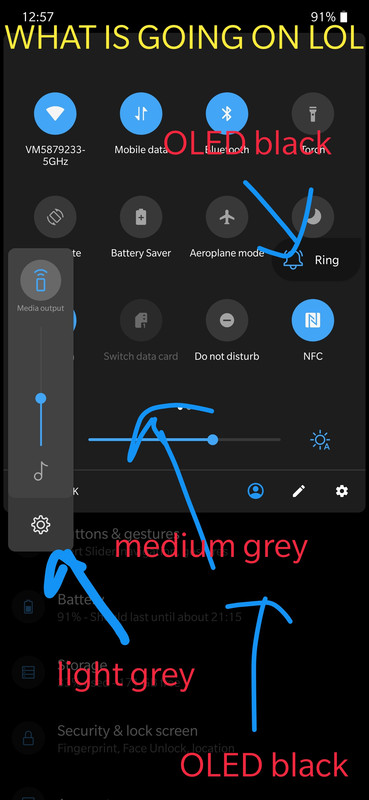
OxygenOS by OnePlus is known to serve one of the finest Android experience among the several overlay skins available. Not only is OxygenOS one of the best skin when it comes to fast and fluid usability and good animations, but also offers a wide scope of customizability. One customization option that has been available in the skin since as early as the OnePlus 3 is the native dark mode, which turns the background colors in the System UI to pitch black to help devices with AMOLED displays save battery. OnePlus made changed to the dark mode with the Android Pie update, adding hints of different grays but this received mixed reactions. Following the OxygenOS 10.0.6 update on OnePlus 7T, the grays in the UI are toned down and replaced by AMOLED black color.

Until Android Oreo, OxygenOS’s dark mode feature predominantly used solid AMOLED black color (#000000) throughout the UI. However, this was changed following the Android 9 Pie update on the OnePlus 6 last year, which is when OnePlus injected different shades of gray. So, with that update, the background of the Quick Settings panel, systems apps, and the floating volume control – all got painted in varying shades of gray. While some users liked the color scheme because it highlighted the Quick Setting menu separately, others were peeved by the discontinuity.

OnePlus 7T XDA Forums

The latter group of users can be satisfied now because OnePlus has updated the colors in the drop-down notification and the quick settings panels. These changes are in line with the unbuilt dark theme in Android 10. Like you can see side-by-side, the OnePlus 7T running Android 10-based OxygenOS v10.0.6 has an AMOLED black versus the grayish panel on the OxygenOS 10.0.2.

Not only that, but the gray on individual quick settings toggles is also darker. The default accent blue is visibly darker but since you can already customize that in OxygenOS using scrubbers or by setting a hex code for the colors, that’s does not make any difference.

Meanwhile, the volume controls in OxygenOS are still gray and we’re not sure whether these will be changed eventually or not. Besides the OnePlus 7T, the new AMOLED black tone is also present in the latest OxygenOS open beta for OnePlus 6T. The OnePlus 7T or the 7T Pro don’t have it yet but we’ll be adding details about other devices when we learn more about the availability in Open beta or stable channels.


Via: Reddit 

The post OxygenOS 10.0.6 tweaks Android 10’s built-in dark mode to use AMOLED black appeared first on xda-developers.

HP Chromebook x360 convertible launched in India in 12″ and 14″ variants

Chromebooks were formerly seen as cheaper alternatives to bigger or bigger and laptops. Apart from premium offerings like the last year’s $999 Pixelbook, the availability of native support for the Google Play Store and Android apps on Chromebooks has helped change the perception to quite an extent. HP is among the manufacturers that spare some SKUs for ChromeOS and has launched two new – 12″ and 14″ – models as part of its x360 series of convertible Chromebooks in India.

HP just announced the availability of these new convertible laptops running on ChromeOS. The HP Chromebook x360 12″ and 14″ models are powered by Intel’s Celeron N4000 CPU, previously part of the Gemini Lake family. Made with a 14nm foundry process, the Intel Celeron N4000 is a low-powered CPU for entry-level laptops. It features a 2-core-2-thread design and has a base and a burst frequency of 1.1GHz and 2.6GHz, respectively. Integrated with the Intel N4000 CPU, there’s an Intel UHD Graphic 600 GPU. HP’s Chromebook x360 series already has a 14″ model that come with Intel Core i3 or Core i5 options.

x360

HP is primarily projecting the new Chromebook x360 laptop duo as entertainment and education devices for the Gen-Z. The 12″ model features a 3:2 aspect ratio instead of the traditional 16:9 to facilitate easy usage in both – landscape and portrait orientations for the display. Further, the touch displays on both laptops support styluses certified for USI (Universal Stylus Interface) and can be used with any USI supported stylus – even with multiple USI styluses at once. The HP Chromebook x360 features a magnetic dock to attach the stylus on the side of the laptop. The HP pen, however, must be bought separately and is not included with either of the laptops. When it comes to the technology behind these displays, both the variants use an HD+ WLED-backlit IPS panel with different resolutions mentioned in the table below.

Complementing the Intel Celeron processor is 4GB of RAM on both models and 64GB of eMMC storage. The storage can be further expanded by another 256GB using a microSD card. For I/O, both the variants get two USB Type-C and a single USB Type-A port.

The new HP Chromebook models get full support for Android apps as well as the Google Assistant. You can also use commands on the laptop to control the smart home equipment in your personal IoT. Additionally, there’s 100GB of Google One Drive storage for a year.


HP Chromebook x360 (Gemini Lake) Specifications

Specifications HP Chromebook x360 12″ HP Chromebook x360 14″ (Gemini Lake)
Dimensions and Weight
  • 272 x 216 x 17.3 mm
  • 1.35kg
  • 324 x 226 x 18.8 mm
  • Starting at 1.58kg
Display
  • 12″ IPS anti-glare WLED-backlit touchscreen
  • Resolution: 1366 x 912
  • 360º hinge rotation
  • 14″ SVA anti-glare WLED-backlit touchscreen
  • Resolution: 1366 x 768
  • 360º hinge rotation
Design 3D metallic keyboard deck with Ceramic White polished cover 3D metallic keyboard deck with Ceramic White polished cover
Processor
  • Intel Celeron N4000
  • Dual-core
  • 1.1 GHz base frequency, up to 2.6 GHz burst frequency
  • 4 MB cache
  • Intel Celeron N4000
  • Dual-core
  • 1.1 GHz base frequency, up to 2.6 GHz burst frequency
  • 4 MB cache
Memory 4GB LPDD4-2400 SDRAM 4GB LPDD4-2400 SDRAM
Graphics Configurations Intel UHD Graphics 600 Intel UHD Graphics 600
Storage Configurations
  • 64GB eMMC
  • Expandable up to 256GB
  • 64GB eMMC
  • Expandable up to 256GB
I/O Ports
  • 2x USB 3.1 Gen1 Type-C (USB + DP 1.2 + PD 3.0)
  • 1x USB 3.1 Type-A
  • microSD card slot
  • Headphone/microphone combo jack
  • 2x USB 3.1 Gen1 Type-C (USB + DP 1.2 + PD 3.0)
  • 1x USB 3.1 Type-A
  • microSD card slot
  • Headphone/microphone combo jack
Connectivity
  • Intel Wireless-AC 9560
  • 802.11a/b/g/n/ac
  • Wi-Fi5 (2×2 MU-MIMO)
  • Bluetooth 5
  • Intel Wireless-AC 9560
  • 802.11a/b/g/n/ac
  • Wi-Fi5 (2×2 MU-MIMO)
  • Bluetooth 5
Camera HP Wide Vision HD Camera with integrated dual array digital microphone HP Wide Vision HD Camera with integrated dual array digital microphone
Audio B&O-tuned dual speakers B&O-tuned dual speakers
Battery Configurations 40.31Wh 47Wh
AC Adapter Configuration USB Type-C 45W USB Type-C 45W
OS ChromeOS ChromeOS
Color Ceramic White, Natural silver Ceramic White, Natural silver

Price & Availability

The new HP Chromebook x360 will be available in India offline as well as via Amazon, Flipkart, and HP’s own online store. The 12″ model is priced at ₹29,990 (~$420) whereas the 14″ Intel Celeron N400 variant will be sold at ₹34,989 (~$490). The HP pen will have to be bought separately for ₹3,999 (~$55).

The post HP Chromebook x360 convertible launched in India in 12″ and 14″ variants appeared first on xda-developers.

TWRP adds support for the Redmi K20 Pro/Mi 9T Pro, Nokia 7.2, and Nokia 6.2

The TWRP custom recovery has been around for several years now and it has grown to become the go-to option for the Android community to install any kind of third-party software on their devices. TWRP’s open-source nature helped it reach popularity across a wide range of devices. On top of that, features like full backup and restore, ADB sideloading, etc. helped the custom recovery cement its position in the market. Now, TWRP is adding support for a few more devices.

Redmi K20 Pro/Mi 9T Pro

The Xiaomi Mi 9T Pro, which is also known as the Redmi K20 Pro in some regions, was launched earlier this year in May. The device packs in top-of-the-line specs, including Qualcomm’s Snapdragon 855 chip, up to 8GB of RAM, and a triple camera setup. While the device has had unofficial TWRP support for a while now, it has now officially received support for the custom recovery.

Official TWRP for the Mi 9T Pro/Redmi K20 Pro

Nokia 7.2

The recently released Nokia 7.2 is a mid-range smartphone that packs in a Snapdragon 660, coupled with up to 6GB of RAM and 128GB of internal storage. The device comes with stock Android out of the box, but if you wish to try out a custom ROM on your phone, you can now use the official TWRP release from the link below to flash a custom ROM.

Official TWRP for the Nokia 7.2

Nokia 6.2

The Nokia 6.2, which was also released alongside the Nokia 7.2, has also received official TWRP support. The device also packs in a mid-range Snapdragon 636 chip, coupled with up to 4GB of RAM and 128GB of internal storage. Thanks to the TWRP support, you’ll now be able to install custom ROMs, kernels, or Magisk modules to add some functionality to the stock OS.

Official TWRP for the Nokia 6.2

The post TWRP adds support for the Redmi K20 Pro/Mi 9T Pro, Nokia 7.2, and Nokia 6.2 appeared first on xda-developers.

Huawei Mate 30 and Huawei Y9 Prime 2019 do not use any US-made components

Huawei’s recent trade ban saga was an unfortunate incident, as it restricted US companies from conducting business with the Chinese company. The most prominent collateral damage in this trade war, to a smartphone enthusiast, was the fact that Huawei’s newer smartphones like the Mate 30 series will be left without the comforting shade of Google Mobile Services. However, the effects of the trade ban extend beyond software, as smartphones from Huawei did come with several components sourced from US companies. But a report from Wall Street Journal suggests that newer batches of Huawei devices like the Huawei Mate 30 and the Huawei Y9 Prime 2019 do not come with any US-based components.

Huawei, much like other smartphone OEMs, depends upon cordial relations among nations to build the advanced pieces of technology that we often take for granted. Smartphones are a result of hardware and software cooperation among multiple entities with varied origins, so harmonious trade relations between powerful nations was considered a pre-requisite for building a globally competitive product. The US trade ban threw a wrench in Huawei’s plan, as companies like Qualcomm, Intel and others were forced to cut ties with the Chinese company. Later on, some companies assessed that they were not to be affected by the trade ban, while others were granted licenses to resume business. In the meantime, Huawei sought alternatives for the crucial components that it previously sourced from US companies. And as it turns out, the company was able to reduce its dependence on US companies for hardware.

According to the Wall Street Journal‘s report citing UBS and Fomalhaut Techno Solutions‘ analysis, newer batches of devices like the Huawei Mate 30 and the Huawei Y9 Prime 2019 do not contain any parts sourced from US companies. For instance, audio amplifiers that used to be sourced from Cirrus Logic, a US company, are now being sourced from NXP, a company based in the Netherlands. Similarly, power management chips that came from ON Semiconductor (US), now see alternates from MediaTek (Taiwan); while antenna switches that were sourced from Qorvo (US), and Skyworks (US), now see alternate options originating from Murata (Japan), and Huawei’s own HiSilicon (China).

This switching over has allowed Huawei to reduce its reliance on US-based suppliers, and in some instances, entirely eliminate US-based options and use other competing suppliers.

The report quotes a statement from a Huawei spokesman:

It is the company’s clear preference to continue to integrate and buy components from U.S. supply partners. If that proves impossible because of the decisions of the U.S. government, we will have no choice but to find alternative supply from non-U.S. sources

The report further mentions that Huawei had anticipated a blacklisting after years of pressure from the US, and so, the company had begun stockpiling spare parts last year which would allow them some extra time in case of a blacklisting situation. The company also began identifying alternatives and working on its own replacement parts.

On the other hand, chip makers like Qorvo, Skyworks, and Broadcom have warned of a hit to their earnings because of the trade ban. So while Huawei appears to be maintaining its momentum because of globalization, others in the US might be feeling the pinch tighter.


Source: Wall Street Journal
Via: The Verge

The post Huawei Mate 30 and Huawei Y9 Prime 2019 do not use any US-made components appeared first on xda-developers.

Kernel sources available for Android 10 updates of Samsung Galaxy S10 series and Xiaomi Mi 9/Redmi K20 Pro

Timely kernel source releases from OEMs give developers and power users a chance to dive deeper into the code that runs their phones. It allows them to figure out ways to improve the phone’s overall performance and capabilities. Kernel source releases also help developers release custom ROMs for the device which, in turn, benefit users who aren’t satisfied with the stock ROM. In a bid to promote third-party development, most OEMs these days release kernel sources within a month or two of their devices hitting the market. Manufacturers like Samsung and Xiaomi have a good track record of releasing kernel sources and they’ve previously released kernel sources for the Android 9 Pie build for the Galaxy S10 series, the Xiaomi Mi 9 and the Redmi K20 Pro. Now, following the recent Android 10 rollout for these devices, the companies have released kernel sources for the Android 10 builds.

Galaxy S10 XDA Forums || Galaxy S10e XDA Forums || Galaxy S10+ XDA Forums || Redmi K20 Pro XDA Forums || Mi 9 XDA Forums

Kernel sources for the Exynos variants of the Samsung Galaxy S10 series are now available on Samsung’s Open Source website (linked below). These include the Galaxy S10e (SM-G970F), the Galaxy S10 (SM-G973F), and the Galaxy S10+ (SM-G975F). The latest releases are at the top of the list and contain the tag ‘QQ’ in the release description. On the other hand, sources for the Xiaomi Mi 9, codename Cepheus, and Redmi K20 Pro are available on GitHub. It’s worth noting that the kernel branch for the Mi 9 and Redmi K20 Pro is the same, so you can download kernel sources for either device from the same link below.

Kernel Sources for the Galaxy S10 Series

Kernel Sources for the Xiaomi Mi 9/Redmi K20 Pro

The post Kernel sources available for Android 10 updates of Samsung Galaxy S10 series and Xiaomi Mi 9/Redmi K20 Pro appeared first on xda-developers.

Imagination’s new A series GPU architecture is the company’s biggest launch in 15 years

The mobile GPU market these days is dominated by Qualcomm’s custom Adreno GPUs and ARM’s Mali GPUs. However, in the past, the situation was different. There were a few more competitors in the mobile GPU market, which helped to increase competitiveness in the industry. Imagination Technologies, in particular, was one of the prime players of the industry. The UK-based company still remains one of the leaders in the mobile GPU space thanks to vendors licensing its GPU technologies, but its own PowerVR-branded GPUs are found in very few products these days. In the past, its high-end mobile GPUs were used by Apple in the company’s A series SoCs, up until the Apple A10 in 2016. Its low-end and mid-range GPUs, on the other hand, are used by companies such as MediaTek, Rockchip, etc. Now, Imagination Technologies is back with a major GPU architecture launch in the form of the new A series architecture. The company is calling it its most important GPU announcement in 15 years, and it’s promoting the new GPUs as having the world’s fastest GPU IP.

To learn how this impacts the mobile GPU market, let’s delve into the company’s background and see how it fits in the mobile GPU market.

Imagination Technologies – Background

Imagination Technologies has historically been one of the leaders in the mobile GPU market, as it has been operating since the 1990s. The company owns a number of GPU IP patents, which means SoC vendors have to pay it licensing fees. Its tile-based deferred rendering (TBDR) technology is a good example. The PowerVR brand of GPUs competed with Qualcomm’s Adreno GPUs and ARM’s Mali GPUs, but after Texas Instruments closed down in 2012, the company’s only licensee at the high-end was Apple.

Apple and Imagination were linked until 2017, as Imagination even built customized versions of its PowerVR GPUs for iPhones and iPads. Apple confirmed that it was in discussion with Imagination to acquire the company in March 2016, but there was no deal. In April 2017, Imagination announced that Apple had told the company it was transitioning to custom GPUs within 15-18 months, moving away from Imagination’s PowerVR GPUs. A couple of months later, Imagination made a shocking announcement: it was putting itself up for sale, and its market capitalization had been significantly reduced in a short time as its biggest customer moved away from using its technology. Imagination was bought in September 2017 by Canyon Ridge, a Chinese equity firm. To say the least, the developments were surprising.

In the same month, Apple launched the A11 SoC alongside the iPhone 8/iPhone X launch. The A11 was said to contain Apple’s first custom GPU. However, Apple continued to pay licensing fees to Imagination as the A11’s custom GPU still used Imagination’s GPU technology (including TBDR). According to AnandTech, Apple’s custom GPU design is commonly regarded to be a fork of Imagination’s IP in 2015, which Apple continues to develop independently thanks to an architectural license. The relationship between Apple and Imagination these days is not known, and officially, Apple’s custom GPU architecture remains a black box.

Having been acquired by Canyon Ridge, Imagination found itself in a position where it had no customer for its high-end GPUs. The company’s PowerVR Rogue architecture had found its way to the iPhone and the iPad at the high end, but after the A11, there were no other buyers. In the low-end and mid-range segments, Imagination continued to license GPU technology to vendors such as MediaTek, Rockchip, and Unisoc. Its PowerVR 8XT and 9XTP architecture didn’t make it to any shipping products, though. In fact, MediaTek migrated from using PowerVR GPUs to using ARM’s Mali GPUs. For example, the Helio P90 used Imagination’s PowerVR GM9446 GPU (that was based on the older Rogue architecture), but MediaTek then moved to ARM’s Mali-G76MC4 GPU in the Helio G90T.

In the meantime, ARM’s Mali GPUs itself were proving uncompetitive in the mobile GPU market, as they had inferior PPA (performance per area) compared to Qualcomm’s custom Adreno GPUs that custom GPU IP, and more recently, Apple’s custom GPUs. ARM’s Mali-G71 and Mali-G72 suffered from inferior performance and power efficiency compared to the Adreno GPUs of that time. While the Mali-G76 was a solid improvement, it still wasn’t enough to take the mobile GPU performance and efficiency crown in the Android market from Qualcomm.

Qualcomm was in a good place in the Android GPU market as its GPUs enjoyed best-in-class performance, but in the wider SoC market, it found itself being beaten by Apple’s custom GPUs. The custom GPUs in the Apple A11, A12, and A13 SoCs are significantly faster than the Adreno 540, Adreno 630, and Adreno 640 in the Snapdragon 835, Snapdragon 845, and Snapdragon 855 respectively. Suddenly, Apple had a big lead in mobile GPU performance, with Qualcomm relegated to second place. ARM’s Mali GPUs were some way behind in terms of PPA as well as power efficiency.

In May this year, ARM set about correcting the performance and efficiency deficit by announcing the Mali-G77 with the new Valhall GPU architecture with 40% performance improvements. The GPU scored its first two design wins in the form of the Samsung Exynos 990 and MediaTek Dimensity 1000 SoCs.

As of mid-2019, the mobile GPU market reflected the reality that custom GPUs developed by Apple and Qualcomm were better than licensed GPUs from the likes of ARM and Imagination. In terms of competition, this is a bad thing for the industry, as it acts as a barrier to competition if the licensed IP is inferior to custom IP that won’t be licensed to any third-party SoC vendor. Samsung knows this, and the company has already committed to licensing AMD’s GPU IP in future Exynos SoCs (set to launch in a two years’ time).

In the face of this background, the stage was set for Imagination’s most important announcement in 15 years.

A series GPU architecture – AXT, AXM, and AXE GPUs

Imagination has announced its new A-series GPU architecture, with the claim of it having the fastest GPU IP ever created. It’s a big claim. The company’s goal here is to show that the architecture is better than the custom GPUs made by Apple and Qualcomm. In essence, Imagination wants to make licensed GPUs viable again, and provide a better alternative than ARM’s Mali GPUs.

The A series architecture is Imagination’s 10th generation GPU architecture. It consists of three categories of GPUs: the XE, XM, and XT product lines, which signify the low-end, mid-range and high-end segments. The PowerVR branding is not used anymore to describe the architecture, as the company now uses it to describe the TBDR tech. The fastest GPU IP claim applies to the XT product line, as it’s intended as a premium series of mobile GPUs.

The A series GPU architecture is claimed by Imagination to be 2.5x faster than Imagination’s previous generation Series 9 GPU in an ISO area and process node comparison. Imagination isn’t comparing A series with the 8XT or the 9XT lines as there are no publicly available products that use those GPU series. AnandTech notes that the data is likely based on the Helio P90’s GM9446 GPU, which is a Rogue-based 9XM series GPU.

The A series has 4x more ALUs over a 9XM Rogue GPU. It’s said to have 8x faster AI performance. Finally, Imagination says that the A series architecture uses 60% lower power for similar performance.

The new A series architecture is applicable for four configurations in the XT series and one XM configuration. The XE series isn’t actually based on the new architecture, as it’s a continuation of Rogue. The AXT-64-2048 is a flagship GPU with 2.0 TFLOPS, 64 gigapixel/s fill rate, and 8 TOPS of AI performance. The AXT-32-1024, on the other hand, is said to be a premium mobile GPU with 1 TFLOPS, 32 Gigapixel/s fill rate, and 4 TOPS of AI performance. The other two configurations are the AXT-48-1536 and the AXT-16-512, while the AXM series has the AXM-8-256, which is rated for 256 GFLOPS, 8 gigapixel/s fill rate, and 1 TOP of AI performance.

In terms of mobile GPUs, Imagination’s plan is to have the AXT-32-1024 as the sweet spot for a premium mobile GPU. The larger two configurations can be used in tablets, for example.

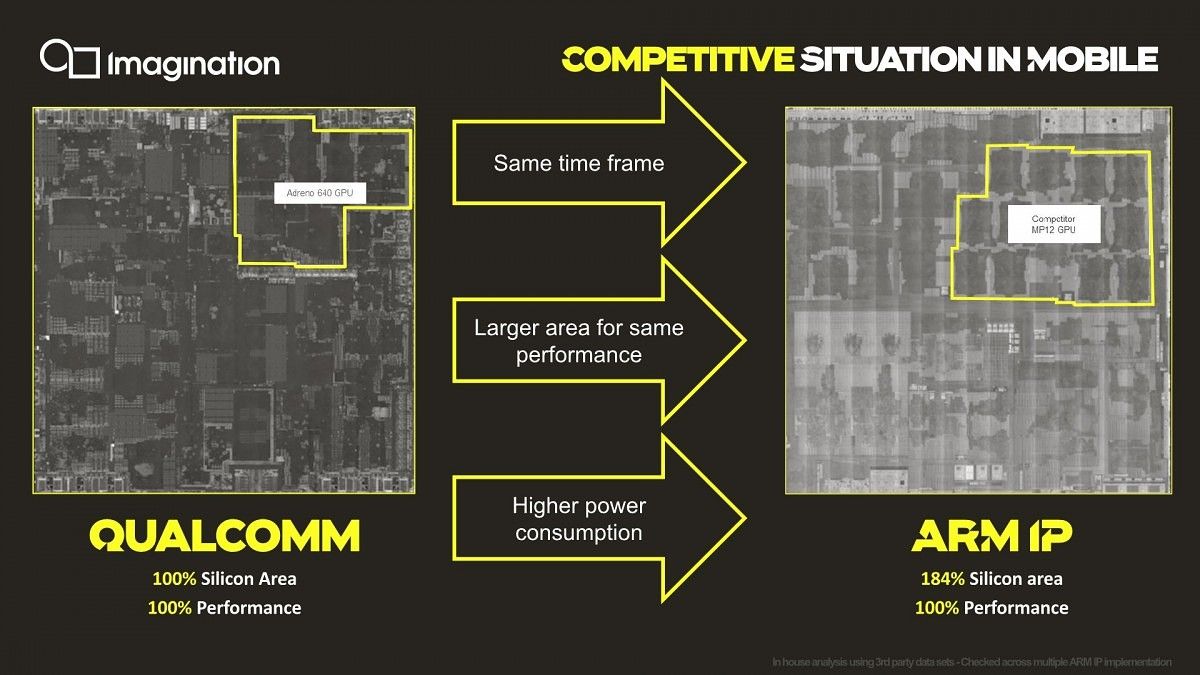
The new GPU IP contains a lot of changes: 4x more ALUs, 128-wide architecture, and a lot more. AnandTech has covered the new A series technology in detail, so readers should check out the publication’s coverage.

A series architecture – Outlook

The outlook of Imagination’s A series architecture looks great. On the face of it, the AXT-32-1024 GPU will be much faster than even next-generation designs such as Qualcomm’s Adreno GPU in the Snapdragon 865 and even Apple’s custom GPU, to say nothing of the Mali-G77. Imagination also has it covered when it comes to PPA, with the company noting the existing problem where the Mali GPUs have the same performance while taking up much more area, leading to lower PPA. The power efficiency should be great as well.

In terms of design wins, it’s a mixed bag. Qualcomm won’t be licensing this architecture, and the vast majority of the world’s Android phones use Qualcomm SoCs. Samsung has already signed a partnership with AMD to use its Radeon IP in future Exynos SoCs. The two major vendors left are Huawei’s HiSilicon Group and MediaTek, which both currently use ARM’s Mali GPUs. As MediaTek has previously used PowerVR GPUs, it’s a possibility that the company will move back to Imagination from ARM in future SoCs. The company has already announced a flagship SoC for 2020 devices in the form of the Dimensity 1000.

Imagination’s announcement of the new A series architecture was much needed in the mobile GPU market. If it all plays out, the mobile GPU market is now much more competitive in terms of licensed GPUs that can be used by multiple vendors.


Via: AnandTech

The post Imagination’s new A series GPU architecture is the company’s biggest launch in 15 years appeared first on xda-developers.

Redmi K30 official teaser shows off quad rear cameras and side fingerprint scanner

Late last month, Xiaomi’s Redmi sub-brand first teased the upcoming Redmi K30. The initial teaser revealed that the device will come with 5G dual-mode 5G support and the attached image suggested that it would feature a dual punch-hole display. Soon thereafter, live images of the device surfaced online which revealed that the K30 will also include a 120Hz display. We also got to know that the device will be powered by Qualcomm’s mid-range Snapdragon 730 or Snapdragon 730G chip. Then, the company’s General Manager, Lu Weibing, announced that the K30 series will be announced on December 10th. Now, just a week ahead of its launch, the company has floated more teasers giving us a first look at its design.

Redmi K30 teaser

As per the recent images shared on Weibo, the upcoming Redmi K30 (5G variant) will feature a quad-camera setup arranged vertically on the back. The camera module itself is housed within a large circle that has a glossy finish, as opposed to the matte finish of the back panel. The dual-LED flash resides right beneath the camera array, outside the circle, with the 5G branding underneath. Other than that, the back of the device is quite clean with the exception of the Redmi branding towards the bottom. The power button resides in a recess on the right edge of the device and houses the fingerprint scanner.

Redmi K30 teaser


The side-mounted fingerprint scanner is a departure from the in-display fingerprint scanner found on the Redmi K20 series, but on the bright side we can expect faster unlock speeds and the recess is definitely a nice touch. The teaser also reaffirms that the device will feature dual-mode 5G, but we don’t get a clear look at the other edges so we don’t have any information on the port selection yet. A different teaser image confirms that the device will feature a dual punch-hole display up on the front, with minimal bezels on all sides. In contrast, the Redmi K20 series featured a single pop-up selfie camera on the top edge.

Redmi smart speaker teaser

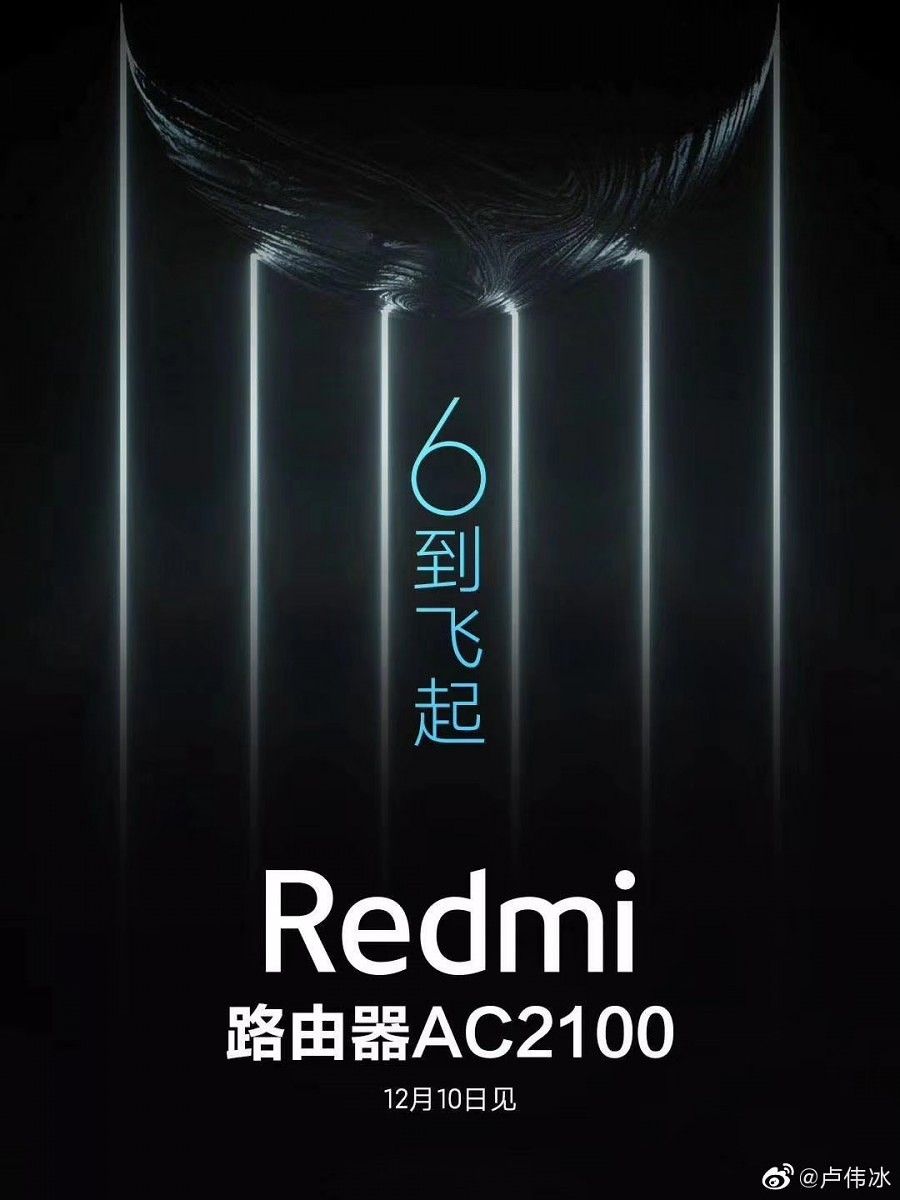
Additionally, Weibing has shared a teaser that reveals that Redmi will be launching its first WiFi router, AC2100, and a smart speaker, Redmi Little Love speaker Play (translated), along with the Redmi K30 series at the upcoming event. As of now, we have no further information about the internal specifications of the upcoming devices. But we expect to learn more as the launch draws closer.


Source: Weibo (1,2,3,4)

The post Redmi K30 official teaser shows off quad rear cameras and side fingerprint scanner appeared first on xda-developers.